
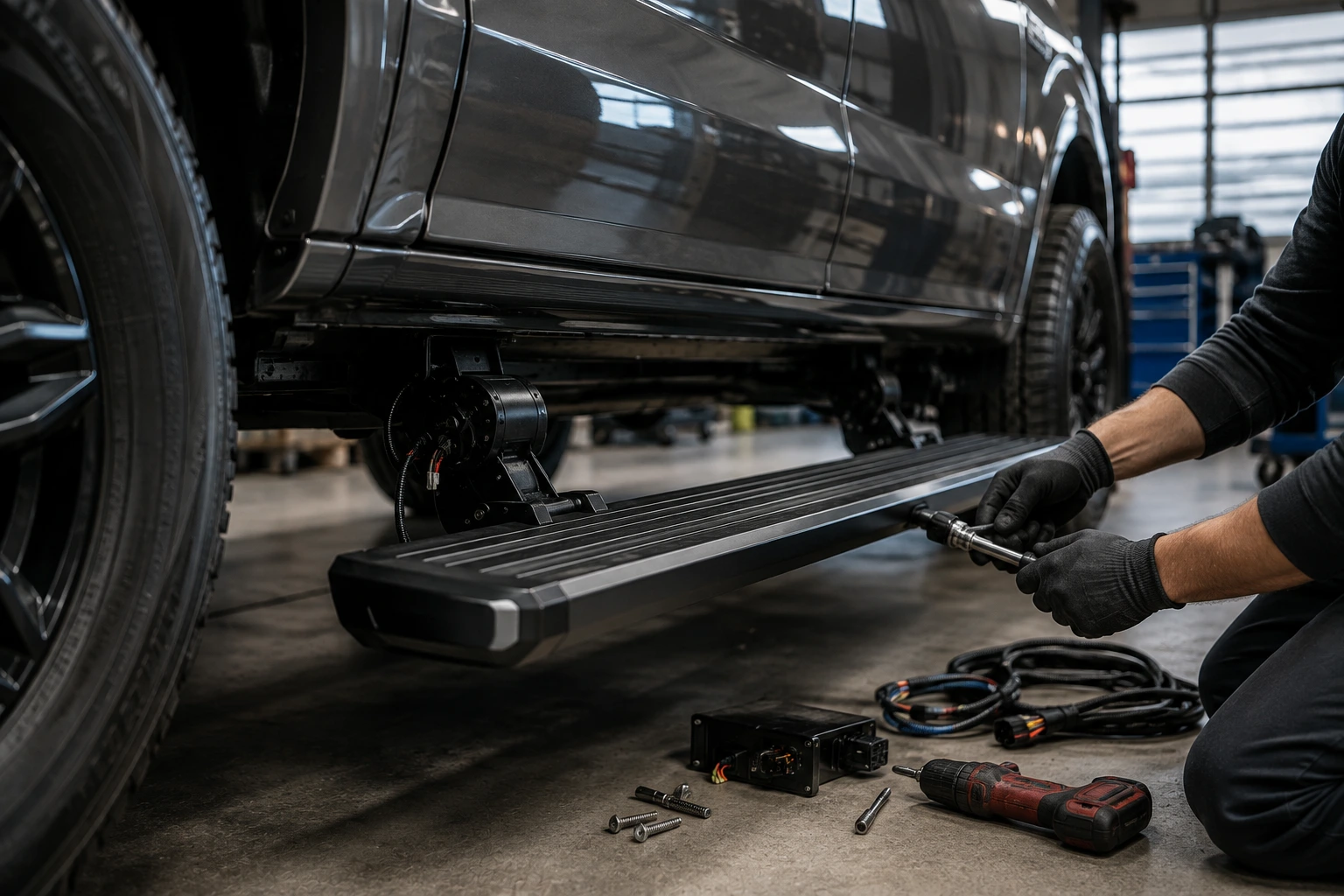
Electric Running Boards, also known as Power Running Boards or Automatic Running Boards, are installed through a process that combines mechanical mounting, motors, wiring, door integration, alignment, and testing. In general, the process starts by verifying vehicle fitment, installing brackets and mechanisms, mounting the boards, completing the electrical connections, and then checking that the steps deploy when the doors open and retract correctly when the doors close.
The exact procedure depends on the manufacturer, vehicle, and specific system, so the instructions for that application should always be followed.
What Should You Check Before Installing Electric Running Boards?
Before starting, confirm that the product is compatible with the vehicle.
Check:
- Year
- Make
- Model
- Cab configuration
- Trim when relevant
- Suspension modifications
- Lift kit
- Product part number
- Mounting requirements
It is not enough for the product to simply say it fits a Ford F-150, Chevy Silverado, or RAM 1500.
The same model may use different applications depending on model year and cab configuration.
How Are Electric Running Boards Installed?
Although each manufacturer may use different components, a professional installation generally follows these steps.
1. Verify Fitment
Before installing any component, confirm:
- Vehicle application
- Cab configuration
- Part number
- Mounting locations
- Hardware
- Electrical requirements
- Included components
Also inspect existing modifications that could interfere with brackets or moving mechanisms.
An incorrect product should not be modified simply to make it fit if the manufacturer does not list that vehicle application.
2. Inspect the Mounting Points
Identify where the brackets and mechanisms will attach.
Many applications use existing factory mounting points, although this depends on the vehicle and product.
Check:
- Mounting locations
- Condition of mounting areas
- Available space
- Hardware
- Existing accessories
- Possible interference
This helps identify problems before installation begins.
3. Install Brackets, Motors, and Linkage
The brackets create the structural connection between the system and the vehicle.
The motors and linkage are then installed so the step can move through this cycle:
Retracted → Deployed → Retracted
Incorrect mounting can cause:
- Uneven movement
- Interference
- Incomplete deployment
- Incomplete retraction
- Misalignment
4. Mount the Running Boards
Once the mechanisms are installed, the Running Boards are attached and adjusted so they:
- Are properly centered
- Maintain a consistent height
- Provide a useful stepping surface
- Do not interfere with the body
- Move freely
The final position depends on the vehicle and product.
5. Complete the Wiring
This is one of the biggest differences compared with Fixed Running Boards.
Electric Running Boards need electrical power and a signal that tells the system when to deploy or retract.
Depending on the system, wiring may involve:
- Power connections
- Ground connections
- Wiring harnesses
- Control modules
- Door signals
- Sensors
- Motors
- LED lighting
The wiring should follow the manufacturer’s routing instructions and remain protected from heat, moving components, and areas where it could be damaged.
6. Integrate the System With the Doors
The normal operating sequence is:
Door opens → Running Board deploys
Door closes → Running Board retracts
How the system receives this information varies by manufacturer and vehicle.
It may use:
- Vehicle signals
- Sensors
- Control modules
- Other vehicle-specific integration
There is no single universal connection that works on every truck.
7. Align and Configure the System
Once mounting and wiring are complete, check:
- Board position
- Clearance from the vehicle
- Linkage movement
- Deployed position
- Retracted position
- Consistency between both sides
Some systems may also require initialization or calibration before final testing.
8. Test Deployment and Retraction
Installation is not complete just because the step moves once.
The system should be tested repeatedly:
- Open the door.
- Confirm the step deploys.
- Close the door.
- Confirm it retracts.
- Repeat on the applicable doors.
- Check both sides.
- Verify there is no interference.
If the system includes LED lighting or other functions, test those as well.
Electric Running Boards vs Fixed Running Boards: What Changes During Installation?
| Fixed Running Boards | Electric Running Boards | |
|---|---|---|
| Mounting | Yes | Yes |
| Brackets | Yes | Yes |
| Alignment | Yes | Yes |
| Motors | No | Yes |
| Moving linkage | No | Yes |
| Wiring | Generally no | Yes |
| Electrical integration | No | Yes |
| Door activation | No | Yes |
| Deployment testing | No | Yes |
| Retraction testing | No | Yes |
Fixed Running Boards are primarily a structural installation.
Power Running Boards add movement and electronics, which makes installation more complex.
Do Electric Running Boards Require Drilling?
Not always.
Many applications use existing factory mounting points, but the requirements depend on the vehicle and product.
Before installation, verify whether the system requires:
- Existing mounting locations
- Additional hardware
- Drilling
- Vehicle-specific modifications
Never assume that one truck uses the same installation procedure as another.
Can Electric Running Boards Be Installed on a Lifted Truck?
Yes.
Electric Running Boards are available for many lifted trucks and can be especially useful because they provide a lower step when the door opens and retract afterward.
Before installation, consider:
- Lift height
- Tire size
- Suspension modifications
- Deployed step height
- Retracted position
- Product fitment
A system that fits the truck model may not be ideal for every lift height.
Can I Install Electric Running Boards Myself?
It depends on your experience and the specific system.
Installation may involve:
- Vehicle-specific mounting
- Electrical wiring
- Vehicle electronics
- Motors
- Linkage
- Alignment
- Calibration
- Troubleshooting
The goal is not simply to make the step move.
It should deploy correctly, sit in the proper position, retract without interference, and operate consistently.
If you do not have experience with automotive electrical and mechanical installation, professional installation may be the safer choice.
Common Electric Running Board Installation Mistakes
Not Verifying Fitment
A product that lists the truck model may not fit every cab configuration or model year.
Ignoring Cab Configuration
Cab configuration can affect board length, brackets, and mounting points.
Copying Electrical Connections From Another Vehicle
Wiring can vary significantly between applications.
Incorrect Wire Routing
Wiring should be protected from heat, moving components, and possible damage.
Not Checking Alignment
A step that deploys is not necessarily installed correctly.
Not Testing the System Enough
Deployment and retraction should be tested several times before the installation is considered complete.
How Long Does It Take to Install Power Running Boards?
There is no universal installation time.
It depends on:
- Vehicle
- Cab configuration
- Product
- Mounting requirements
- Wiring complexity
- Vehicle modifications
- Condition of mounting points
- Calibration requirements
In general, Electric Running Boards require more installation work than Fixed Running Boards because they include electrical components and moving mechanisms.
Professional Electric Running Board Installation in South Charleston, WV
At Running Boards and More Store, we help truck and SUV owners choose and install Electric Running Boards, Power Running Boards, and Automatic Truck Steps compatible with their vehicles.
Before installation, we can verify:
- Year
- Make
- Model
- Cab configuration
- Lift kit
- Tire size
- Existing modifications
- Product fitment
Depending on the system, installation may include:
- Mounting
- Brackets
- Motors and linkage
- Wiring
- Electrical integration
- Alignment
- Calibration
- Deployment testing
- Retraction testing
We provide professional installation in South Charleston, West Virginia, for customers in Charleston and surrounding communities.
Frequently Asked Questions About Electric Running Board Installation
How Are Electric Running Boards Installed?
The process generally includes verifying fitment, installing brackets, motors, and linkage, mounting the boards, completing the wiring, integrating the system with the doors, aligning the steps, and testing deployment and retraction.
Is It Difficult to Install Electric Running Boards?
It can be more complex than installing Fixed Running Boards because it combines mechanical mounting with wiring, motors, and vehicle integration.
Do Electric Running Boards Need Wiring?
Yes. Power Running Boards need electrical power and a way to determine when they should deploy and retract.
Do They Need Sensors?
It depends on the product. Some systems use sensors, while others rely on existing vehicle signals.
Do You Have to Drill the Vehicle?
Not always. Many applications use factory mounting points, although this depends on the specific system.
Can They Be Installed on a Lifted Truck?
Yes. Options are available for many lifted trucks, but lift height, tire size, and deployed step position should be checked.
How Do I Know If They Were Installed Correctly?
The system should be properly mounted and aligned, deploy and retract consistently, and operate without interference.
So, How Should Electric Running Boards Be Installed?
Installing Electric Running Boards generally follows this sequence:
Fitment → Mounting → Motors & Linkage → Running Boards → Wiring → Door Integration → Alignment → Testing
There is no universal electrical or mechanical installation procedure because each manufacturer and vehicle can use a different configuration.
A proper installation is about more than simply making the Running Board move. The complete system should be properly mounted, correctly connected, aligned, and tested.
At Running Boards and More Store, we can help verify which Power Running Boards are compatible with your vehicle and provide professional installation in South Charleston, WV.
Get a Quote for Your Truck or SUV Upgrade
Prefer to Speak With Us?
Call us directly and speak with a product specialist.
- Serving Charleston, WV and surrounding areas.
- Mon–Fri: 9:00 AM – 5:00 PM