
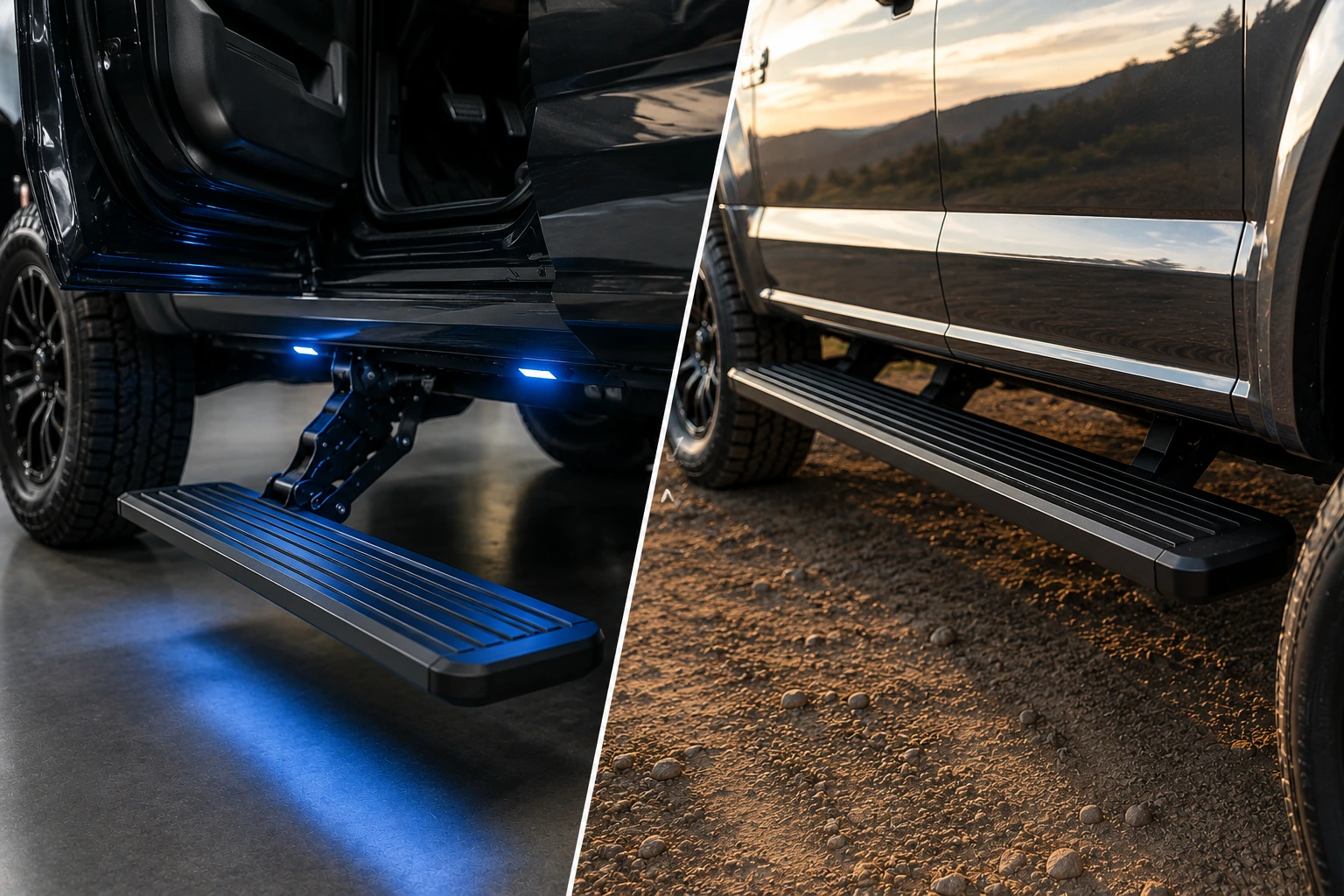
The main difference between Power Running Boards vs Fixed Running Boards is simple: Power Running Boards automatically deploy when you open the door and retract afterward, while Fixed Running Boards remain in position at all times.
Power systems usually make more sense if you have a lifted truck, care about ground clearance, want a cleaner side profile, and are willing to pay more for automatic deployment. Fixed systems usually make more sense if you want simplicity, lower cost, constant availability, and fewer mechanical or electrical components.
There is no universally better option. The right choice depends on how you use your truck.
Power vs Fixed: Quick Comparison
| Power Running Boards | Fixed Running Boards | |
| Operation | Deploy and retract | Remain fixed |
| Electricity | Yes | Generally no |
| Ground clearance | May improve when retracted | Depends on mounting position |
| Initial cost | Higher | Generally lower |
| Complexity | Higher | Lower |
| Availability | Deploy when the door opens | Always available |
| Appearance | Cleaner when retracted | Always visible |
| Maintenance | Mechanical + electrical | Mainly structural |
If your priority is technology + retractability + clearance, start by looking at Power Running Boards.
If you prioritize simplicity + price + constant availability, Fixed Running Boards usually make more sense.
How Does the Everyday Experience Change?
With Fixed Running Boards, the step is always below the cab.
There is no deployment cycle, motor, or sensor involved. You open the door and use the platform.
With Power Running Boards, opening the door activates the system and the step lowers automatically. Once the doors close, it retracts again.
This difference may sound small, but it can change the daily experience considerably.
For someone who gets in and out of a work truck repeatedly, having the step permanently available can be practical.
For someone with a lifted truck who wants a lower step when entering but does not want it extended while driving, Power may be more appealing.
Advantages of Power Running Boards
Better Step Position for Tall Trucks
On a lifted truck or a vehicle with larger tires, the distance between the ground and cab can increase significantly.
A Power Running Board can deploy to a more accessible position when you need to get in.
What matters is how low the step actually sits when deployed, not simply that the system is electric.
They May Improve Ground Clearance
When retracted, many Power Running Boards sit closer to the body than certain Fixed systems.
This can be useful for:
- Lifted trucks
- Trucks with larger tires
- Uneven terrain
- Off-road-inspired builds
However, brackets, motors, and mechanisms still remain beneath the vehicle.
That is why actual clearance depends on the specific product and mounting position.
Cleaner Appearance
When retracted, the Running Board can become much less visible.
This is often attractive on trucks that already have:
- Wheels
- Tires
- Suspension upgrades
- Blackout packages
- Exterior accessories
Automatic Deployment
You do not need to manually deploy the step.
Open the door, it lowers.
Close the doors, it retracts.
For a daily driver, this convenience may be used many times every day.
Advantages of Fixed Running Boards
Simplicity
Fixed Running Boards do not need motors or sensors to remain available.
This lower complexity can be an important advantage if you simply want a functional step.
Lower Cost
They generally cost less than a comparable Power system.
If you do not need retractability or automatic deployment, you can avoid paying for features you may not use.
Fewer Moving Components
Fixed systems still require maintenance and inspection, but they do not depend on:
- Motors
- Wiring
- Sensors
- Linkage
- Control modules
Always Available
This can be especially practical on work trucks.
There is no deployment cycle.
You simply use the step whenever you need it.
Are Power Running Boards Worth the Extra Cost?
They can be when you actually use the features that make them different.
They make more sense if:
- You have a lifted truck.
- You use larger tires.
- Ground clearance is important.
- You want a lower step when entering.
- You prefer a clean side profile.
- You value automatic deployment.
- You are building a premium truck.
In these situations, you are not simply paying for “a more expensive Running Board.”
You are paying for features that a Fixed system cannot provide.
When Does It Make More Sense to Choose Fixed Running Boards?
Fixed can be the better choice if:
- You only need easier access.
- You want to control the budget.
- You use a work truck.
- You prefer fewer electrical components.
- You do not need additional ground clearance.
- You want a platform that is always available.
A Fixed Running Board is not an inferior option.
For many trucks, it is simply the more logical solution.
Which Is Better for a Lifted Truck?
In many cases, Power Running Boards have an advantage on lifted trucks because they can provide a lower stepping position when entering and then retract afterward.
However, that does not mean Power is automatically right for every lifted truck.
You should check:
- Lift height
- Tire size
- Deployed step height
- Retracted position
- Cab configuration
- Intended use
A properly positioned Fixed Running Board can also work perfectly if you do not need retractability.
The key is making sure the step sits at a truly useful height.
Which Is Better for a Work Truck?
For many work trucks, Fixed Running Boards have a practical advantage.
If you get in and out constantly throughout the day:
- The step is always available.
- You do not have to wait for deployment.
- Fewer components are involved.
- The system can be simpler to maintain.
However, a very tall or lifted work truck may benefit from Power if easier access becomes the higher priority.
Which Is Better for a Family or Daily Driver?
Both can work.
Here, it makes sense to look beyond Power vs Fixed and consider:
- Step height
- Step width
- Grip
- Front and rear door coverage
- Passenger height
- Frequency of use
For children, older passengers, or shorter passengers, the final step position may matter more than the mechanism itself.
Which Is Better for Off-Road Use?
Power has a potential advantage because it can retract.
A Fixed Running Board remains below the side of the truck while driving, while a Power system may sit more tucked away.
But there is an important distinction:
Running Boards are not automatically Rock Sliders.
If you use your truck for aggressive off-road driving or expect impacts with rocks, you should look at accessories specifically designed for structural protection.
For occasional use on uneven terrain, clearance may be enough to make Power more appealing.
Cost and Maintenance: What Really Changes?
Fixed Running Boards
You should generally inspect:
- Brackets
- Hardware
- Finish
- Corrosion
- Step surface
- Alignment
Power Running Boards
In addition to the above, they may include:
- Motors
- Linkage
- Pivot points
- Wiring
- Sensors
- Electrical connections
- Deployment and retraction mechanisms
That does not mean Power systems are going to fail.
It simply means there is more mechanical and electrical complexity.
Product quality and installation quality are especially important.
Power vs Fixed in West Virginia Weather
In West Virginia, both types can be exposed to:
- Rain
- Snow
- Ice
- Mud
- Road salt
- Dirt
- Gravel
Fixed systems can accumulate dirt on surfaces, brackets, and hardware.
Power systems also include moving mechanisms that need to remain clean enough to operate correctly.
During winter, paying attention to snow, ice, and road salt buildup can help keep the system working properly.
This is not a reason to avoid Power Running Boards, but it is an important maintenance consideration.
What Should You Check Before Deciding?
Before buying Power or Fixed Running Boards, confirm:
- Year, Make, and Model
- Cab Configuration
- Factory Height or Lift Height
- Tire Size
- Ground Clearance Requirements
- Daily, Work, Family, or Off-Road Use
- Who Uses the Vehicle
- Exact Product Fitment
Two Running Boards that fit the same truck can still provide different step heights and mounting positions.
That is why the category alone should not determine your choice.
What Happens If a Power Running Board Stops Working?
A Power Running Board that does not deploy does not automatically mean the motor has failed.
The issue could be related to:
- Dirt or debris
- Obstruction
- Linkage
- Wiring
- Electrical connections
- Sensor
- Motor
- Control system
The system should be diagnosed before replacing components.
With a Fixed Running Board, problems are more commonly related to:
- Board
- Brackets
- Hardware
- Mounting points
- Alignment
- Physical damage
The difference comes back to the same idea: Power offers more features, while Fixed offers less complexity.
Professional Power and Fixed Running Board Installation in South Charleston, WV
At Running Boards and More Store, we help truck and SUV owners compare systems based on:
- Year
- Make
- Model
- Cab configuration
- Lift height
- Tire size
- Intended use
- Product fitment
For Fixed Running Boards, installation may include mounting, brackets, alignment, and hardware inspection.
For Power Running Boards, installation may also involve wiring, motors, linkage, electrical integration, and deployment testing.
We provide professional installation in South Charleston, West Virginia, for customers in Charleston and surrounding communities.
Frequently Asked Questions About Power vs Fixed Running Boards
What Is the Main Difference Between Power and Fixed Running Boards?
Power Running Boards deploy automatically and retract afterward. Fixed Running Boards remain permanently installed below the vehicle.
Are Power Running Boards Worth It?
They can be worth it if you value automatic deployment, retractability, easier access, and ground clearance. If you only need a simple step, Fixed may be enough.
Do Power Running Boards Cost More?
Generally, yes. They include motors, wiring, sensors, and additional mechanisms.
Do Power Running Boards Provide Better Ground Clearance?
They may offer an advantage when retracted, although actual clearance depends on the design and mounting position.
Are Fixed Running Boards Simpler?
Yes. They generally use fewer mechanical and electrical components and remain available at all times.
Which Lasts Longer?
There is no universal answer. Fixed systems have fewer moving parts, but the lifespan of both depends on quality, installation, climate, use, and maintenance.
Final Verdict: Power Running Boards vs Fixed Running Boards
The choice between Power Running Boards vs Fixed Running Boards depends on which features you actually need.
Choose Power Running Boards if you prioritize:
- Automatic deployment
- Lifted truck access
- Ground clearance
- Retractability
- Cleaner appearance
Choose Fixed Running Boards if you prioritize:
- Simplicity
- Lower cost
- Constant availability
- Fewer moving components
- Straightforward everyday use
Neither option is universally better.
The best choice is the one that fits your truck, cab configuration, ride height, tire size, passengers, budget, and how you use the vehicle.
At Running Boards and More Store, we can help you compare Power and Fixed Running Boards, verify compatibility, and provide professional installation in South Charleston, WV.
Get a Quote for Your Truck or SUV Upgrade
Prefer to Speak With Us?
Call us directly and speak with a product specialist.
- Serving Charleston, WV and surrounding areas.
- Mon–Fri: 9:00 AM – 5:00 PM