
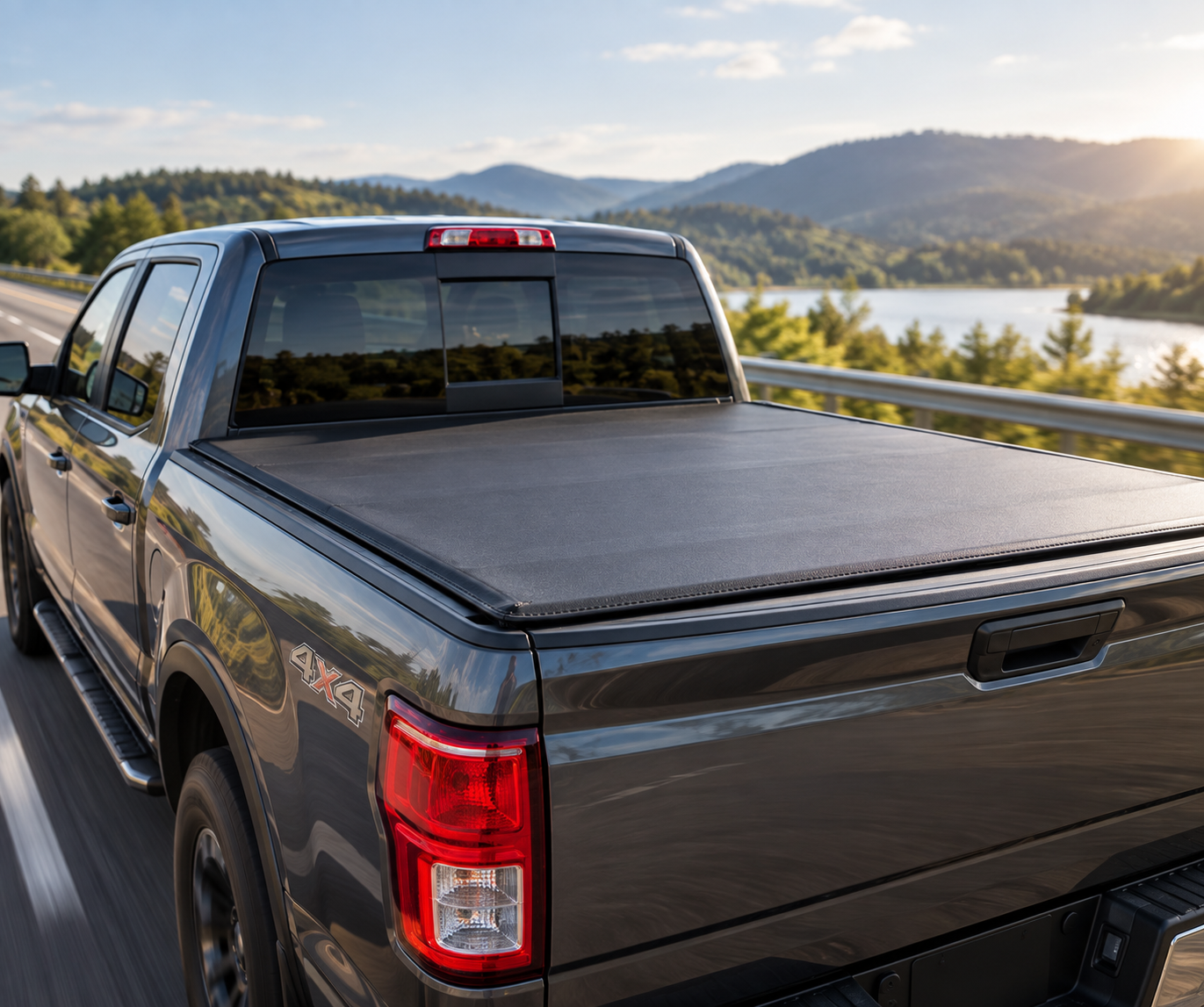
Tonneau covers can reduce aerodynamic drag, but they do not guarantee better gas mileage. Some wind-tunnel testing suggests that covering a pickup bed can modestly improve aerodynamics and potentially produce a small fuel-economy benefit, while real-world road testing has also found little improvement—or even slightly worse MPG in certain conditions.
That means you should not buy a tonneau cover expecting a dramatic change at the gas pump.
For most truck owners, the better reasons to install one are cargo protection, keeping belongings concealed, improving how the truck bed is used, and creating a cleaner finished appearance. Any fuel-economy benefit should be treated as a possible bonus rather than a guaranteed return on investment.
Why Would a Tonneau Cover Affect Gas Mileage at All?
At highway speeds, your truck has to push through a large amount of air.
That creates aerodynamic drag, which is resistance acting against the vehicle as it moves forward.
Pickup trucks are particularly interesting from an aerodynamic standpoint because air moves over the cab and interacts with the open bed before leaving the rear of the vehicle.
A tonneau cover changes that airflow by creating a surface across the top of the truck bed.
In theory, smoother airflow can reduce some aerodynamic resistance and therefore reduce the amount of energy required to maintain speed.
That basic idea is reasonable.
The complicated part is determining whether the aerodynamic improvement is large enough to create a noticeable MPG difference in the real world.
What Does the Research Actually Show?
The evidence is mixed, which is exactly why claims such as “a tonneau cover will increase your MPG by X percent” should be treated carefully.
Here is a simplified look at two frequently cited tests:
| Test | What Was Tested | Result |
| SEMA wind-tunnel research | Multiple tonneau cover configurations | Covers reportedly reduced aerodynamic drag by roughly 5% on average, translating to an estimated fuel-economy improvement of around 1–2% in some conditions |
| Consumer Reports road test | 2013 Ram V8 at 65 mph with tailgate up, down, and soft tonneau cover | Truck achieved 22.3 MPG with tailgate up and no cover, versus 21.4 MPG with the soft tonneau cover |
The SEMA research suggests there can be an aerodynamic benefit, but reducing drag does not translate directly into the same percentage of fuel savings. AmericanTrucks summarizes the wind-tunnel findings as roughly a 5% reduction in drag with an estimated fuel-economy improvement of about 1.8% for some covers.
Consumer Reports reached a very different result in its 2013 road test. Using a Dodge Ram V8 at 65 mph, it measured 22.3 MPG with the tailgate up and no cover, compared with 21.4 MPG with a factory soft tonneau cover installed.
Neither test proves what every truck will experience.
What they demonstrate is that the answer depends heavily on the truck, cover, speed, conditions, and testing method.
Wind-Tunnel Results and Real-World MPG Are Not the Same Thing
This distinction is important.
A wind tunnel can measure how a cover changes aerodynamic drag under controlled conditions.
Your MPG, however, is influenced by much more than aerodynamics.
It also depends on:
- Driving speed
- Acceleration habits
- Traffic
- Wind direction
- Terrain
- Tire pressure
- Vehicle weight
- Cargo load
- Engine and transmission
- Weather
- Idling
- City versus highway driving
A small aerodynamic improvement can easily disappear inside normal day-to-day MPG variation.
For example, if one tank includes more highway driving and another includes more stop-and-go traffic, the difference may be larger than anything caused by the tonneau cover itself.
Highway Driving Is Where Aerodynamics Matter Most
If a tonneau cover does provide an MPG benefit, it is more likely to matter during steady highway driving than during slow city driving.
Aerodynamic drag increases as speed rises.
At low speeds, factors such as acceleration, braking, engine load, and vehicle weight play a larger role relative to aerodynamic resistance.
At highway speeds, the truck spends more energy pushing through the air.
That is why many aerodynamic claims around tonneau covers focus on sustained highway use.
A driver who spends several hours per week cruising at highway speeds may have a better chance of noticing a small difference than someone whose truck mostly makes short trips around town.
Even then, the effect may be difficult to separate from wind, temperature, traffic, and driving behavior.
The Open Truck Bed Is More Aerodynamically Complicated Than It Looks
One common explanation says:
An uncovered bed catches air like a parachute.
That description is too simple.
Air flowing over a pickup cab can create a recirculating pocket or vortex inside the bed. That airflow pattern means the tailgate and open bed do not behave exactly like a flat wall pushing against the air.
Consumer Reports’ test is a good example of why assumptions can be misleading. Lowering the tailgate did not improve MPG; it actually reduced measured fuel economy in that test.
So although covering the bed changes airflow, the aerodynamic outcome depends on the entire truck design rather than simply eliminating an “open hole” behind the cab.
Modern pickup manufacturers also spend significant engineering effort managing airflow around the cab, bed, tailgate, underbody, and mirrors.
Can the Weight of the Cover Offset Aerodynamic Benefits?
Potentially.
A tonneau cover adds weight to the truck.
A lightweight cover may add relatively little, while some rigid or more elaborate systems can be substantially heavier.
Added weight matters most during:
- Acceleration
- Stop-and-go driving
- Climbing hills
- Frequent short trips
Aerodynamic efficiency matters more during steady-speed highway driving.
This creates another reason real-world results vary.
A cover that slightly reduces drag may still provide little measurable MPG difference if additional weight, driving conditions, or other variables offset that advantage.
AmericanTrucks also identifies cover weight as one factor that can reduce or offset potential aerodynamic gains.
How Much MPG Improvement Should You Expect?
There is no responsible universal number.
Some sources estimate modest improvements in the 1–2% range based on drag-reduction testing, while other tests have found no improvement or worse MPG under specific conditions.
To put a small percentage into perspective:
If a truck normally gets 20 MPG, a 1% improvement would be only:
20.2 MPG
A 2% improvement would be:
20.4 MPG
That difference can be difficult to distinguish from ordinary variation between tanks.
So if someone promises that adding a tonneau cover will immediately give your truck several extra miles per gallon, that claim deserves skepticism.
Will a Tonneau Cover Pay for Itself in Gas Savings?
Usually, fuel savings should not be the main financial argument for buying a tonneau cover.
Even if your truck experiences a small improvement, the annual savings depend on:
- Miles driven
- Fuel price
- Existing MPG
- Highway percentage
- Actual aerodynamic change
A tonneau cover can certainly provide value, but most of that value comes from what it does for the truck bed, not from fuel savings alone.
More practical benefits include:
- Keeping cargo covered
- Reducing direct weather exposure
- Keeping tools and personal belongings out of sight
- Making the bed easier to organize
- Improving everyday usability
- Creating a cleaner appearance
If MPG improves slightly, consider that an additional benefit.
How Can You Tell Whether Your Own Truck Improved?
If you really want to measure the effect, do not rely only on the MPG display immediately after installation.
Track fuel economy over several tanks.
For a better comparison:
- Fill the tank consistently.
- Record mileage driven.
- Calculate actual MPG.
- Compare similar driving patterns.
- Separate highway-heavy tanks from city-heavy tanks.
- Avoid drawing conclusions from one tank.
Even with careful tracking, wind, temperature, traffic, and cargo weight can influence the result.
You may find a small trend over time, but expecting an obvious change after one drive is unrealistic.
Other Factors Usually Matter More for MPG
If your main goal is reducing fuel consumption, several factors can have a larger effect than adding a tonneau cover.
Pay attention to:
- Tire pressure
- Highway speed
- Unnecessary cargo weight
- Aggressive acceleration
- Extended idling
- Vehicle maintenance
The purpose of this article is not to turn into a general fuel-economy guide, but the context matters:
a tonneau cover is not a substitute for efficient driving habits and proper vehicle maintenance.
So, Do Tonneau Covers Help Gas Mileage?
The most accurate answer is:
They can improve aerodynamics, but a measurable MPG improvement is not guaranteed.
Wind-tunnel research has found reductions in aerodynamic drag with certain tonneau covers, which suggests the potential for a small fuel-economy benefit. But real-world testing has produced mixed results, including Consumer Reports’ test where the tonneau cover slightly reduced measured highway MPG.
Your result will depend on:
- Truck design
- Cover design
- Cover weight
- Highway speed
- Driving conditions
- Cargo
- Weather
- Driving habits
For that reason, gas mileage should be treated as a secondary consideration when choosing a tonneau cover.
Frequently Asked Questions About Tonneau Covers and MPG
Do tonneau covers increase MPG?
They may improve aerodynamics and can potentially produce a small MPG benefit, particularly during highway driving, but an increase is not guaranteed.
How much gas can a tonneau cover save?
There is no universal savings figure. Some aerodynamic testing suggests a small potential fuel-economy improvement, while other real-world tests have found no benefit.
Does a tonneau cover help more on the highway?
Potential aerodynamic benefits are more relevant at highway speeds because aerodynamic drag becomes more significant as vehicle speed increases.
Should I buy a tonneau cover just to save gas?
Probably not. Cargo protection, security, bed usability, and appearance are generally stronger reasons to purchase one.
Does leaving the tailgate down improve gas mileage?
Not necessarily. Consumer Reports found that lowering the tailgate on its test truck actually reduced measured highway fuel economy compared with leaving it up.
Does the type of tonneau cover affect fuel economy?
Potentially, because cover shape, weight, profile, and rigidity can influence airflow. However, the differences are generally too small and variable to make fuel economy the primary reason for choosing one style over another.
Choose a Tonneau Cover for How You Use Your Truck
If you are shopping for a tonneau cover, choose based primarily on fitment, cargo needs, bed access, security, and everyday convenience.
Running Boards & More Store can help you find vehicle-specific tonneau cover options for your truck and provide professional installation for customers throughout Charleston, South Charleston, Dunbar, Nitro, Cross Lanes, St. Albans, Hurricane, and nearby West Virginia communities.
send us your truck’s year, make, model, and bed size, and our team can help you find compatible options.
Get a Quote for Your Truck or SUV Upgrade
Prefer to Speak With Us?
Call us directly and speak with a product specialist.
- Serving Charleston, WV and surrounding areas.
- Mon–Fri: 9:00 AM – 5:00 PM